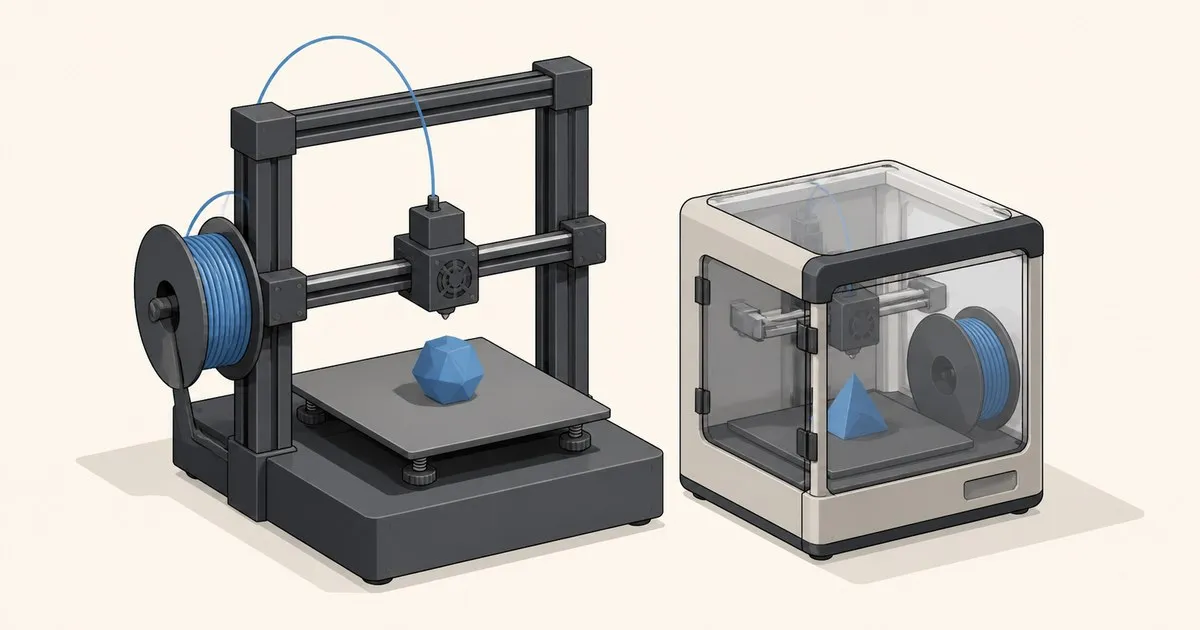
Best Creality Printer for PLA and PETG: Ender-3 V3 KE
The Ender-3 V3 KE combines a 300 C hotend, 100 C bed, and textured PEI for PLA and PETG, with K1C, Hi, and V3 Plus alternatives compared.
PLA and PETG requirements: 250 °C hotend, 90 °C bed, textured PEI that releases cooled PETG; no enclosure. At current Creality prices, the Ender-3 V3 KE at $259 is default: 300 °C hotend, 100 °C bed, textured PEI, Klipper-based input shaping, 220 x 220 x 240 mm volume. The K1C at $369 adds a camera and usually open lid. Choose the Creality Hi at $299 when 220 mm is too small or a CFS is planned. $199 Ender-3 V3 SE prints both, but its 260 °C ceiling and 2500 mm/s² acceleration cap make it the budget choice.
What PLA and PETG actually need
Prusa’s PLA page: Prusament PLA, 215 °C first layer, 210 °C thereafter, 60 °C bed; other brands, 185 to 235 °C. Its PETG page: 230 °C then 240 °C; bed 85 to 90 °C. Creality’s PETG guide, updated February 2026: 230 to 250 °C, starting 240 °C; bed 70 to 90 °C. Minimum: 250 °C hotend, 90 °C bed. Every current Creality bed reaches 100 °C. The SE’s 260 °C nozzle gives 10 °C PETG margin. Other models’ 300 °C ratings reflect heater capacity, not material need. The KE’s 60 W ceramic heater and bi-metal heatbreak sustain melting at 300 mm/s.
CNC Kitchen: peak layer adhesion, PLA 40 MPa at 230 °C; PETG 32 MPa at 245 °C, falling to 24 MPa at 260 °C. Use the low end for appearance, high end for structural parts.
For PETG, plate surface is critical. Prusa warns smooth PEI can grip too hard, recommends glue stick as separator and prefers powder-coated texture. Tom’s Hardware’s KE review says the KE’s textured PEI “doesn’t require glue stick when printing PETG or TPU.” The SE’s PC-coated sheet still needs glue stick.
Enclosures can harm PLA. Prusa’s heat creep article: printing PLA “in a fully closed and unventilated enclosure is very likely to cause problems.” Creality’s K2 Plus chamber guide: 35 °C for PLA, PETG and TPU because hotter chambers soften them in the extruder. K1C PLA: lid off.
The lineup on paper
| Printer | Build volume (mm) | Max speed / accel | Nozzle / bed max | Plate | Frame | Store price |
|---|---|---|---|---|---|---|
| Ender-3 V3 SE | 220 x 220 x 250 | 250 mm/s / 2500 mm/s² | 260 / 100 °C | PC-coated steel | Open | $199 |
| Ender-3 V3 KE | 220 x 220 x 240 | 500 mm/s / 8000 mm/s² | 300 / 100 °C | Textured PEI | Open | $259 |
| Ender-3 V4 | 220 x 220 x 235 | 500 mm/s / 12000 mm/s² | 300 / 100 °C | PEI | Open | $369 as Combo with CFS |
| Ender-3 V3 (CoreXZ) | 220 x 220 x 250 | 600 mm/s / 20000 mm/s² | 300 / 110 °C | PEI | Open | $239 |
| Creality Hi | 260 x 260 x 300 | 500 mm/s / 12000 mm/s² | 300 / 100 °C | Epoxy-resin steel sheet | Open | $299, $399 Combo |
| Ender-3 V3 Plus | 300 x 300 x 330 | 600 mm/s / 20000 mm/s² | 300 / 100 °C | PEI | Open | $339 |
| K1C | 220 x 220 x 250 | 600 mm/s / 20000 mm/s² | 300 / 100 °C | PEI | Enclosed CoreXY | $369 |
Sources: Creality support pages for temperatures, speeds and accelerations: SE, KE, V4, Ender-3 V3, Hi, K1C; omitted build volumes: 3DJake’s listings. Prices: Creality US store, 27 August 2026; several sold out with late-August ship dates. Creality labels the 600 mm/s rows lab figures at 0.1 mm layers, with 300 mm/s typical. Creality K1 vs Ender-3 V3 explains.
The pick for most people: Ender-3 V3 KE
The KE is the cheapest stock Creality meeting all three: 300 °C, 100 °C, boxed textured PEI, direct-drive Sprite extruder, CR Touch plus strain-gauge Z offset, Wi-Fi, Klipper-based Creality OS with input shaping. On a 220 mm bed, 8000 mm/s² versus the SE’s 2500 mm/s² determines print time; Ender-3 V3 SE vs KE gives the arithmetic.
Tom’s Hardware, February 2024: both materials tested; speed-test Benchy, 19 minutes 48 seconds; GreenGate3D recycled PETG print, 2 hours 24 minutes, using Creality Print’s stock PETG profile with volumetric speed capped at 9 mm³/s, the honest untuned ceiling. Assembly: 15 minutes. The omitted input-shaping accelerometer cost $12.50 then; order it too.
The newer Ender-3 V4 shares the footprint and limits: 300 °C, 100 °C, 12000 mm/s², PEI, port for up to four CFS units. Drawbacks: 235 mm Z, only the $369 Combo stocked when checked, far less published testing than the KE’s two years. V4 Combo suits multicolour PLA; for single-colour PLA and PETG, the KE matches its material envelope for $110 less.
When the extra money is justified
K1C, $369. All-metal hotend, hardened steel nozzle, AI camera. PLA and PETG: lid off. Premium adds CoreXY consistency under heavy parts and future ABS or ASA capability. K1 Max vs K1C explains when the 300 mm cube matters.
Creality Hi, $299 (Combo $399). Tri-metal nozzle, 0.6 and 0.8 mm options; CFS filament cutter. Tom’s Hardware’s September 2025 review: trouble-free PLA and PETG, speed-boat Benchy in 32 minutes 33 seconds, complete TPU failure. If its extra 40 mm over the KE matters and TPU does not, the Hi is better value.
Ender-3 V3 Plus, $339. CoreXZ, 300 x 300 x 330 mm. Buy only for volume.
Ender-3 V3 (CoreXZ), $239. K1C volume, 110 °C bed, 20000 mm/s² and $20 under the KE; newer motion system, less community tuning.
Who should buy the SE, and who should skip Creality
SE, $199: PLA at 180 mm/s; PETG at 120 mm/s. Tom’s Hardware’s SE review used the latter for a 51 minute PETG print at 0.2 mm. Limits: 260 °C nozzle, 2500 mm/s², no input shaping, SD card only, PC plate. Day-one textured PEI makes a sound second batch-PLA printer. Nylon or polycarbonate needs a heated chamber: skip Creality; K2 Plus belongs elsewhere. At the KE’s price, Bambu A1 vs A1 Mini covers the direct competitor; PLA vs PETG vs ABS covers materials.
Starting settings on a KE, and what changes on a K1C
PLA: 215 °C first layer, 210 °C after; bed 60 °C; fan off layers 1 and 2, then 100% per Creality’s PLA guide; 0.2 mm layers, 3 walls; outer wall near 100 mm/s, acceleration 5000 mm/s² until shaper calibration; retraction starts at 0.5 mm, 40 mm/s.
PETG: 240 °C, or 245 °C for structural parts; bed 80 °C; fan off first 3 layers, then half power per Prusa; retraction starts at 0.8 mm, 30 mm/s; max volumetric speed 9 mm³/s pending flow test. New stringing spool: Creality recommends drying at 55 to 65 °C for 4 to 6 hours. Retraction advice conflicts: Prusa recommends more and lower nozzle temperature; Creality, shorter and slower than PLA. Calibrate each spool. Too-close Z offset fuses PETG to the sheet; how to set Z offset on the Ender-3 V3 covers adjustment.
K1C: same settings; PLA lid off; PETG lid on permitted. Mid-print extruder clicks suggest heat creep first; nozzle clog and heat creep fixes gives triage.
How to verify
- OrcaSlicer calibration menu temperature tower: PLA 200 to 230 °C; PETG 225 to 255 °C; 5 °C steps. Orca’s guidance: choose the band midpoint with cleanest bridges and least stringing, or upper end for higher speed or flow.
- Retraction tower: Orca’s test defaults direct drive to 0 to 2 mm in 0.1 mm steps. Choose shortest clean section; low-ooze filaments often clean at 0.2 to 0.4 mm. Stringy top: dry filament, check nozzle seat.
- Max volumetric speed: Orca’s flow test runs 5 to 20 mm³/s in 0.5 steps. At matte surface or layer failure, measure height, compute 5 + height x 0.5, reduce 10 to 20%, save the filament profile. Flow, not headline, then governs speed.
- Speed-boat Benchy: 2 walls, 3 top and bottom layers, 10% infill, 0.25 mm layers, 0.5 mm width. Tom’s Hardware references: 32:33 Hi, 41:00 SE under those rules, 19:48 KE speed test. Pass: clean cabin-door bridge, string-free chimney, hull lines without bow ringing.
Creality store and 3DJake links are plain and non-affiliate; Creality joins no affiliate programme used here.
Related on this site
Sources
- Creality Ender-3 V3 KE support page (specifications)
- Creality Ender-3 V3 SE support page (specifications)
- Creality K1C support page (specifications)
- Creality Hi Combo support page (specifications)
- Creality Ender-3 V4 support page (specifications)
- Creality Ender-3 V3 support page (specifications)
- 3DJake: Creality Ender 3 V3 KE listing (build volume)
- Tom's Hardware: Creality Ender 3 V3 KE review
- Tom's Hardware: Creality Ender 3 V3 SE review
- Tom's Hardware: Creality Hi Combo review
- Prusa Knowledge Base: PETG
- Prusa Knowledge Base: PLA
- Creality blog: What Is PETG? Properties, Printing Settings & Practical Uses
- Creality blog: PLA Print Temperature
- CNC Kitchen: The Influence of Extrusion Temperature on Layer Adhesion
- OrcaSlicer wiki: Temperature calibration
- OrcaSlicer wiki: Retraction test
- OrcaSlicer wiki: Max Volumetric Speed calibration
- Creality Wiki: K2 Plus chamber temperature setting guide
- Prusa Knowledge Base: Extrusion stopped mid-print (heat creep)
Related

Creality Ender 3 V3 SE vs KE: Key Differences
The SE has a 2500 mm/s2 acceleration limit and an SD-only workflow; the KE adds Wi-Fi, a 300 C hotend, and an 8000 mm/s2 ceiling.

Creality 3D Printer Buying Guide for Beginners
Which Creality printer suits a first purchase, how the Ender-3 V3 and K1 lines differ on speed and enclosure, and the setup that decides week one.

Creality K1 Max vs K1C: Build Volume or the Better Hotend?
The K1 Max provides a 300 mm cube, AI LiDAR, and Ethernet; the K1C has a quick-swap Unicorn nozzle and a rated 45 dB silent mode.