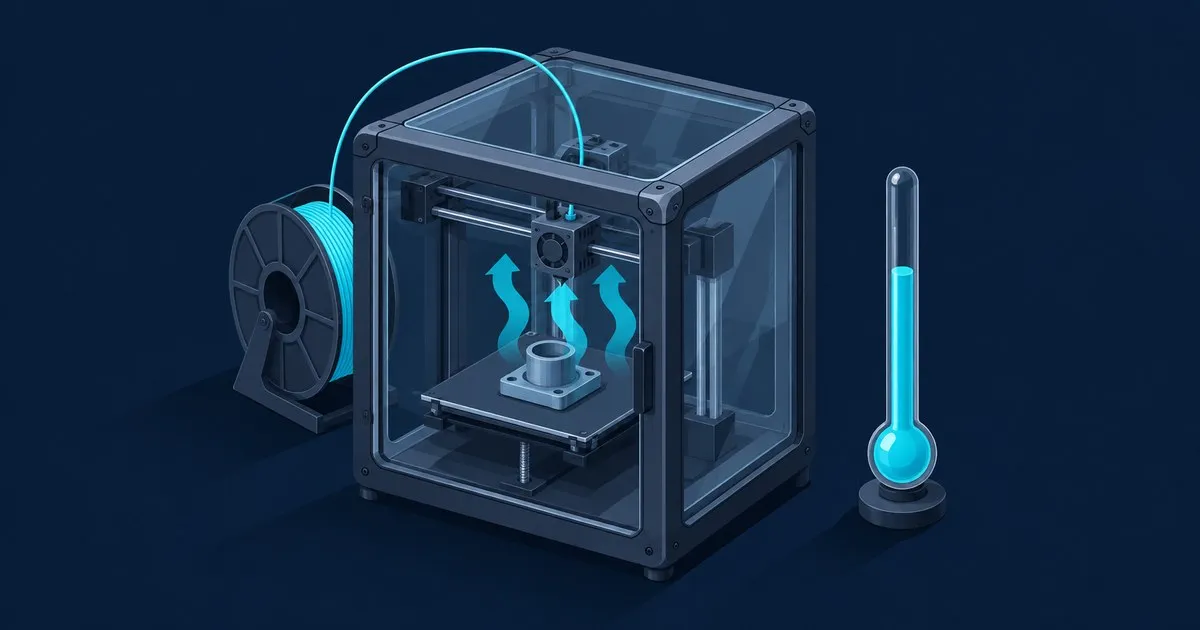
Creality K1 Enclosure Temperature Limits
Creality lists no chamber rating for the K1 series. This guide explains the passive enclosure's real temperature range and practical limits.
Search for Creality K1 enclosure temperature limits and you get forum guesswork, because Creality never published a figure. The spec sheet rates the hotend and the bed and says nothing about the chamber. That silence is the answer: the K1, K1C and K1 Max have a passive enclosure with no heater, so the only real limits are the temperature the box drifts to on its own and the temperature at which something inside it starts failing.
Creality publishes no chamber rating for the K1 series
The official K1C specification table lists nozzle temperature at ≤300 °C and heatbed at ≤100 °C, alongside 220×220×250 mm, ≤600 mm/s and ≤20000 mm/s². There is no chamber temperature row on Creality’s K1C page, nor on the K1 or K1 Max pages.
Creality’s own wiki explains why. The K2 Plus chamber temperature guide opens with “Compared to other flagship models, K2 Plus introduces active chamber temperature control, with a maximum chamber temperature of 60 °C.” The word “introduces” is doing the work: that 60 °C ceiling belongs to the K2 generation and its chamber heater.
OrcaSlicer agrees at the profile level. The shipped Creality K1 (0.4 nozzle) machine profile sets support_chamber_temp_control to 0, with auxiliary_fan and support_air_filtration at 1; the K1 Max profile matches. Orca will not emit M191 or M141 for these machines because nothing on the other end would obey them.
What the passive chamber actually reaches
Chamber heat on a K1 comes from the bed, the hotend block, the motors and the PSU, trapped by the glass door, acrylic sides and magnetic top cover. 3D Print Beginner measured 46 °C with a thermometer during ABS prints in their K1 review, noting the enclosure thermistor is not exposed in the stock interface. Treat 40 to 50 °C as the realistic band, closed up, bed at 100 °C, side fan off.
Compare that against OrcaSlicer’s chamber temperature table: 50–70 °C for ABS and ASA, 70–100 °C for nylon 6 and 12, 80–100 °C for PC. A stock K1 lands just under the ABS band and nowhere near the others. ABS and ASA are workable; large flat PC and PA parts will still warp, and no slicer setting changes that. The per-material breakdown lives in PrintLabGuide’s chamber temperature reference.
The firmware ceiling is a cooling setpoint, not a heater
Creality OS is a modified Klipper, and the K1’s config carries a temperature_sensor chamber_temp plus a temperature_fan chamber_fan. Klipper’s temperature_fan documentation describes that object as “a fan that will be enabled whenever its associated sensor is above a set temperature,” with a default target_temp of 40.0 °C and a default min_speed of 0.3.
That inverts what most people expect from M141. On a K1, a chamber target tells the exhaust fan when to start pulling air out: a ceiling, not a goal. Creality wired that loop up in CrealityOS V1.3.3.5. The official changelist records: “Upgrade the control of the chamber cooling fan. Its spin or pause is now controlled by the chamber temperature, instead of default settings.”
Which is why both Creality wiki pages give the same instruction for hot materials. The K1C parameter page says “When printing ABS/ASA or engineering filaments, it’s recommended to manually turn off the chamber fan,” and the K1 Max page repeats it for the enclosure fan. You are not raising a setpoint, you are disabling the thing holding the chamber down.
The three limits that actually bite
The PTFE feed path, around 40 °C. Orca’s documentation is blunt: “Low temperature filaments like PLA can clog the nozzle if the chamber temperature is too high,” and for PLA, PETG and TPU the chamber “should be low to avoid extruder clogging caused by material softening at the heat break.” Creality’s K1C troubleshooting page lists “Filament Clogged in the Teflon Tube of Hot End” among four named clog causes, and the K2 guidance puts low-temperature materials at 30–35 °C. The polymer physics are identical on a K1. Diagnosis order is in Creality nozzle clog and heat creep fixes.
The electronics bay. The K1 separates the print chamber from the board compartment in the base, but the base still heats up. A Helper Script proposal asked to move [temperature_fan soc_fan] from a 50.0 °C target to 43.0 °C; the maintainer settled on 45 °C. A real limit with a real number, and nowhere near the chamber air.
Filtration efficiency. Orca notes that “a higher chamber temperature will reduce the efficiency of air filtration for ABS and ASA.” The hottest chamber is not automatically the right one.
Concrete settings by material
Creality’s K1-series filament table gives the nozzle and bed numbers. The enclosure column is the part nobody writes down.
- PLA (Hyper PLA 220 °C / 45 °C bed, 300 mm/s at 0.2 mm layer, 23 mm³/s, model fan 100%, side fan 80%). Top cover off, front door open, chamber fan on. Chamber under ~35 °C.
- PETG (250 °C / 70 °C bed, 120 mm/s, 9 mm³/s, model fan 80%, side fan 0%). Cover on is fine, but leave the chamber fan enabled. PETG tolerates more than PLA and still softens in the feed tube.
- ABS and ASA (260 °C / 100 °C bed, 250 and 150 mm/s, 20 and 15 mm³/s, model fan 70% and 80%, side fan 0%). Cover on, door closed, chamber fan off. Let the bed soak until
chamber_tempplateaus before the first layer. Expect low-to-mid 40s. - PA-CF and PC (250–260 °C / 100 °C bed). The K1 runs them; it will not hit their 70–100 °C chamber bands. Design around the warp rather than chase a setting. Material behaviour is compared in PLA vs PETG vs ABS.
How to verify on your own machine
Read the number first. The stock touchscreen does not surface chamber_temp. Rooting the printer and installing Fluidd or Mainsail exposes it; otherwise run a thermocouple through the filament pass-through, taped clear of the bed.
The test print is a 60×60×5 mm flat plate in ABS, 0.2 mm layers, 4 walls, 15% gyroid, brim off. Success criterion: corner lift under 0.2 mm against a flat reference. If the corners lift and the chamber reads below 40 °C, the fan is still running.
For the opposite failure, run a 3+ hour PLA print with the cover closed and the fan disabled, then repeat with the cover off. If the closed run starts clicking at the extruder and under-extruding in hour two while the open run finishes clean, the chamber cooked the filament in the PTFE tube. That is the elimination test that separates a heat-soaked feed path from wet filament, and it beats blaming a spool. Retraction-side symptoms are covered in the K1 stringing fix; hardware differences are in K1 Max vs K1C.
Sources
- Creality K1C product page (official specifications)
- Creality Wiki: K1C/K1C 2025 Print Parameter Settings
- Creality Wiki: K1 Max Printing Parameter Settings
- Creality Wiki: K2 Plus Chamber Temperature Setting Guide
- Creality Wiki: CrealityOS V1.3.3.5 firmware changelist (K1 / K1 Max)
- Klipper Config Reference: temperature_fan
- OrcaSlicer documentation: Material Temperatures (print chamber temperature)
- OrcaSlicer machine profile: Creality K1 (0.4 nozzle)
- 3D Print Beginner: Creality K1 Review
- Creality Helper Script Wiki discussion #607: mainboard temperature limit
Related

Creality K1 Stringing Fix: Retraction, Heat and Drying
This Creality K1 stringing fix covers filament drying, nozzle temperature, retraction, wipe, and pressure advance settings for PLA and PETG.

Creality CR Touch Not Probing: Diagnosis and Fixes
A Creality CR Touch that will not probe is diagnosed by LED state and pin motion, followed by wiring, firmware, offset, and speed checks.

Creality Ender 3 V3 SE vs KE: Key Differences
The SE has a 2500 mm/s2 acceleration limit and an SD-only workflow; the KE adds Wi-Fi, a 300 C hotend, and an 8000 mm/s2 ceiling.